A hotel booking engine is the software that lets guests check availability, choose a room and rate, and pay directly on the hotel's website. Connected to the PMS or channel manager, it is the place where direct bookings are made, without OTA commission, so its speed and ease of use weigh directly on revenue.
Key takeaways
- The booking engine turns website visits into commission-free direct bookings.
- It must be connected to the PMS or channel manager to keep availability and rates in sync.
- Main providers include D-EDGE, Mews, SynXis (Sabre), SiteMinder, Bookassist and Cendyn; the right choice depends on the hotel's size and tech stack.
How does a hotel booking engine work?
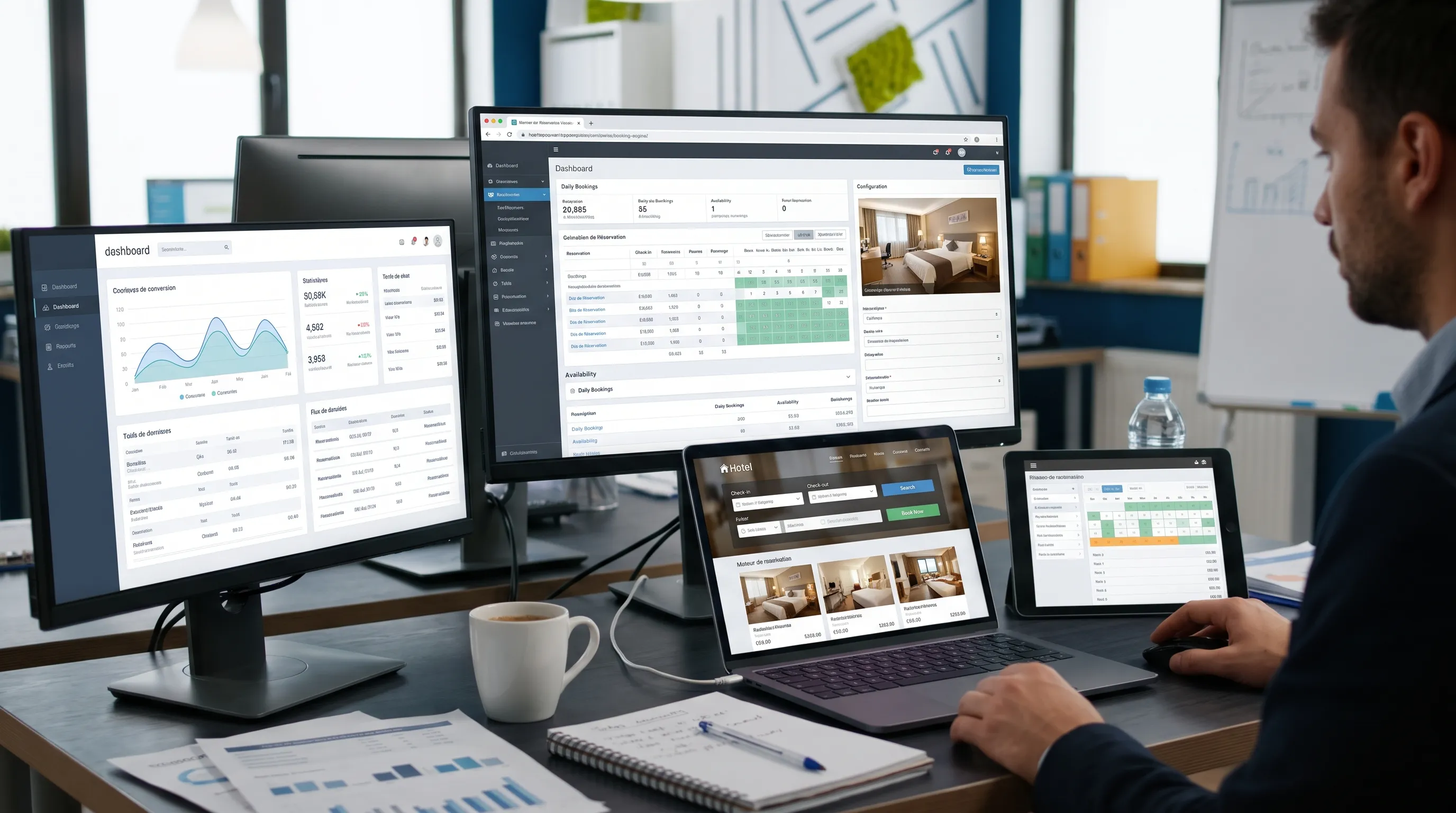
When a guest clicks "Book now", the booking engine opens, often on a dedicated subdomain. It displays real-time availability and rates fed by the PMS, channel manager or central reservation system (CRS), takes the guest's details and payment, then sends the booking back to the PMS. It can also feed rates to metasearch engines such as Google Hotel Ads, which require a direct price feed.
What features should a good booking engine have?
- Mobile-first and fast: most travelers browse on their phone; every extra step costs bookings.
- Brand consistency: colors, fonts and photos in line with the website. See whether the booking engine theme can match your website.
- Flexible rates and offers: member rates, packages, promo codes, add-ons such as breakfast or spa.
- Secure payment: major cards, digital wallets and strong customer authentication.
- Connectivity: two-way link with the PMS and channel manager, and with metasearch. See the advantages of connecting the booking engine to your PMS.
- Multi-language and multi-currency for international guests.
Who are the main hotel booking engine providers?
The market includes D-EDGE, Mews, SynXis (Sabre), SiteMinder, Bookassist and Cendyn, among others. Some are part of a full suite (PMS, CRS, channel manager), others focus on direct bookings and marketing. The list is not a ranking: the right provider depends on the number of properties, the existing PMS, the markets and the budget.
How do you choose a hotel booking engine?
- Check compatibility with your PMS, channel manager and metasearch connections.
- Test the mobile booking flow yourself, from the search to the payment.
- Compare the pricing model: monthly fee, commission per booking or a mix.
- Ask how tracking works with Google Analytics 4 and ad platforms.
- Check installation time and support. See how long installing a booking engine takes and how to install one.
How do you track bookings made through the booking engine?
Because the booking engine often runs on another domain, tracking must follow the guest from the website to the confirmation page: cross-domain tracking in Google Analytics 4, a purchase event with booking value, and conversion tags for Google Ads and Meta. Without it, campaigns cannot be judged on the revenue they bring. Mobile conversion is a frequent weak point, as we explain in solving the problem of conversion on mobile.
How does Influence Society approach booking engines?
At Influence Society, we treat the booking engine as part of the website, not a separate tool. We check that its design matches the site, that tracking reports every booking and that its flow converts on mobile, then use it as the end point of every campaign aimed at increasing direct bookings.
Sources: Google Help, About Google third-party rates for hotel ads (direct price feed requirement from September 30, 2026); HOTREC European Hotel Distribution Study, 2025 data, via Hospitality Net (accessed November 2026).
FAQ
What is the difference between a booking engine and a channel manager?
The booking engine sells rooms on the hotel's own website. The channel manager distributes availability and rates to OTAs and other channels, and keeps them in sync with the PMS.
Does a booking engine charge commission?
It depends on the provider. Some charge a monthly fee, others a commission per booking or a mix; in all cases it is usually far lower than OTA commission.
Do I need a booking engine to appear on Google Hotel Ads?
In practice, yes. Google Hotel Ads requires a direct price feed, usually sent by a booking engine or channel manager that is a Google integration partner.