A hotel channel manager is the software that sends a hotel's availability, rates and restrictions to all its sales channels at once (Booking.com, Expedia, Airbnb, Google, wholesalers) and brings their bookings back into the PMS. Its job is to keep every channel up to date in real time, avoid overbookings and save the team from updating each extranet by hand.
Key takeaways
- The channel manager distributes; the PMS manages the stay; the booking engine sells on the hotel's own website.
- Large channel managers connect to hundreds of channels: SiteMinder, for example, lists more than 500.
- Under the Digital Markets Act, Booking.com can no longer impose rate parity in the EU, which gives the channel manager a more strategic role in setting different rates by channel.
How does a channel manager work?
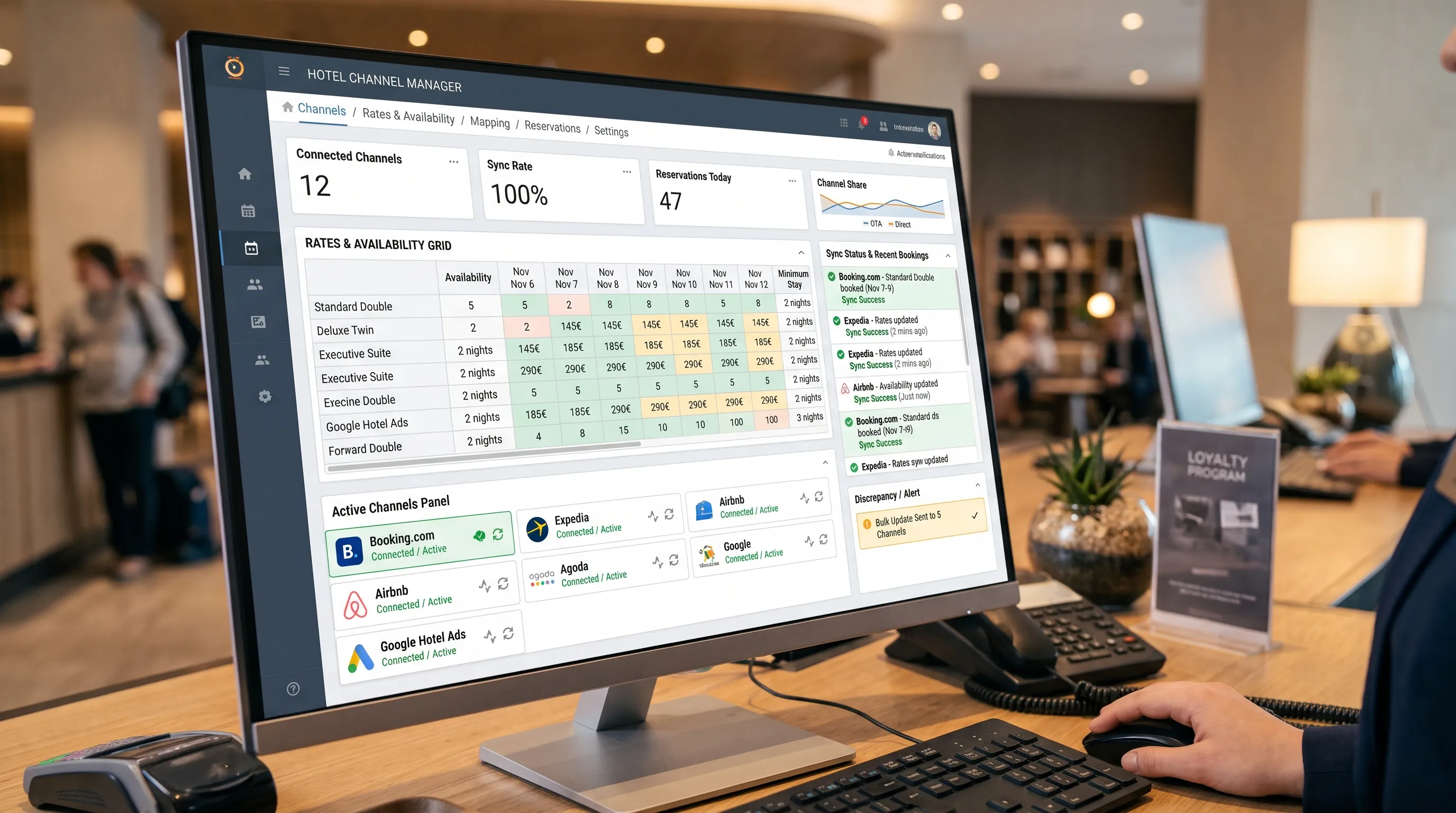
The hotel sets its rooms, rates and restrictions (minimum stay, closed to arrival) once, in the channel manager or in the PMS connected to it. The channel manager pushes these values to every connected channel. When a room is booked on one OTA, the booking comes back into the PMS and the availability drops everywhere else at the same time. This two-way connection is what prevents selling the last room twice.
What is the difference between a PMS, a booking engine and a channel manager?
- PMS: runs the hotel's operations, from bookings to check-in and billing.
- Booking engine: sells rooms on the hotel's own website, with no commission.
- Channel manager: distributes rooms to external channels (OTAs, metasearch, wholesalers) and centralizes their bookings.
Some suites combine the three; others connect separate tools. What matters is that they share one inventory.
What are the benefits of a channel manager for a hotel?
- Fewer overbookings: availability updates everywhere as soon as a room is sold.
- Time saved: one update instead of one per extranet.
- Wider distribution: opening a new market or channel takes a few clicks.
- Rate control: rates and restrictions by channel, from one place.
- Reporting: production and cost by channel, to compare with direct bookings.
How should a hotel manage rates across channels?
For years, parity clauses forced hotels to show the same price everywhere. In the EU, the DMA now prevents Booking.com from imposing them, so a hotel can keep its best rate or perks for its own website. The channel manager makes this practical: one base rate, with rules by channel. Keep in mind that each OTA booking carries a commission; our article on how much OTAs charge gives the figures, and our guide to increasing direct bookings explains how to rebalance the mix.
How does Influence Society work with channel managers?
At Influence Society, we look at the channel manager from the marketing side: is the direct rate competitive, are metasearch and Google free booking links fed correctly, and what share of revenue comes through each channel? We help hotels use the OTAs reached through the channel manager for visibility, while the website and booking engine capture the most profitable bookings.
Sources: SiteMinder, Channel Manager (accessed November 2026); European Commission, How the DMA ensures businesses using Booking.com are free to set their prices, September 28, 2026.
FAQ
Does a hotel need a channel manager if it only sells on Booking.com?
Not always: with one OTA and a booking engine, manual updates can work. As soon as a second OTA or a wholesaler is added, the risk of overbookings makes a channel manager worthwhile.
Does a channel manager completely prevent overbookings?
It greatly reduces them by updating availability in real time. Overbookings can still happen with connection delays or bookings entered by hand outside the system.
Can a hotel set different prices by channel with a channel manager?
Yes. Rules by channel let the hotel adjust rates and restrictions. In the EU, the DMA also allows it to offer a better price on its own website than on Booking.com.