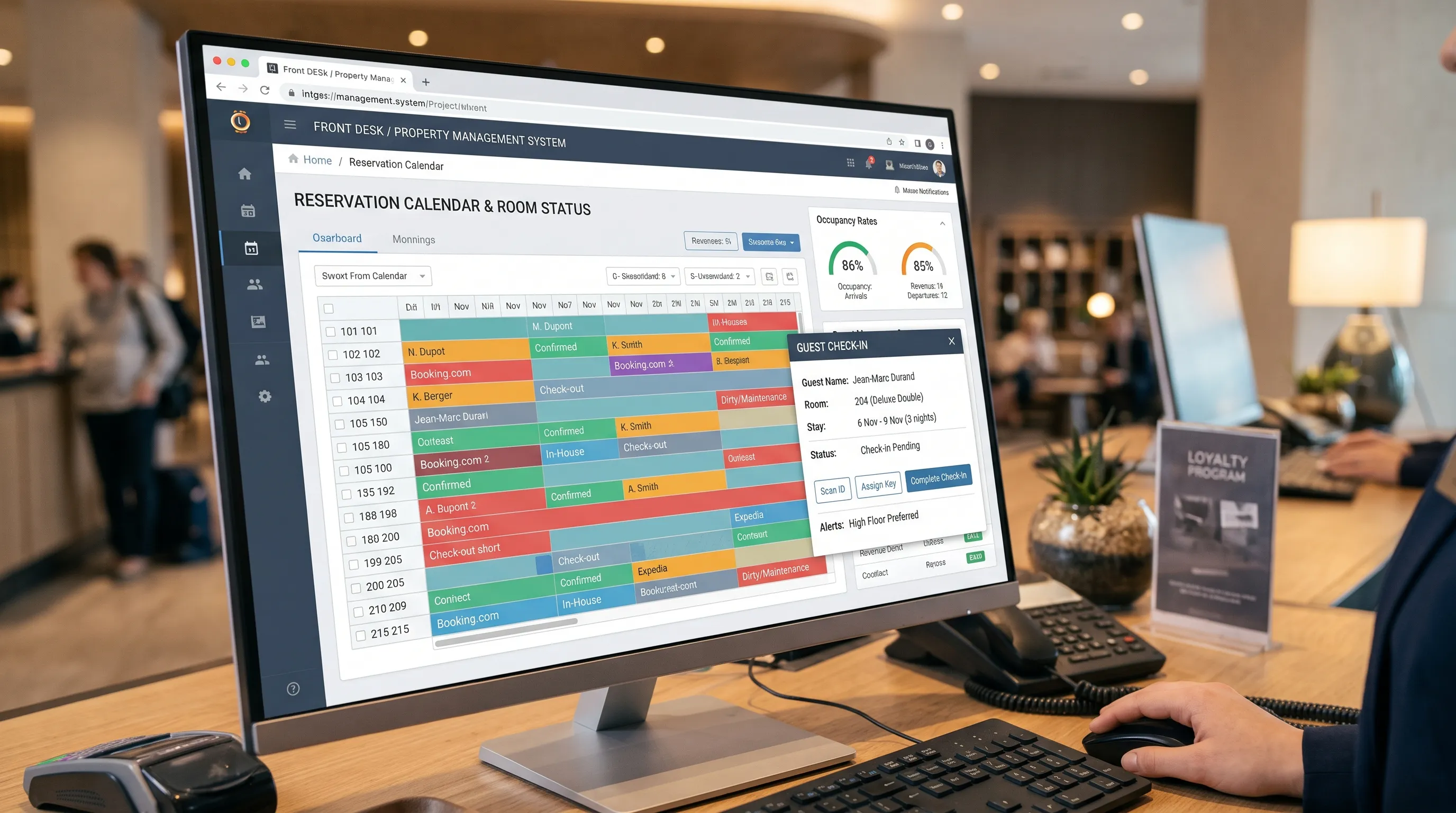
A hotel PMS (property management system) is the software that runs a hotel's daily operations: reservations, room inventory and rates, check-in and check-out, housekeeping, billing and reporting. It is the central database of the hotel, to which the booking engine, channel manager, CRM and other tools connect.
Key takeaways
- The PMS is the hotel's source of truth for rooms, rates, bookings and guest stays.
- Most new PMS projects are now cloud-based: Oracle reports a 31% year-on-year increase in properties on Opera Cloud, and Hyatt is moving more than 1,000 hotels to it.
- A PMS is only as good as its integrations: booking engine, channel manager, CRM, payments and point of sale.
What does a hotel PMS do?
- Reservations: creating, changing and cancelling bookings from every channel.
- Rooms and rates: room types, availability, rate plans and restrictions.
- Front desk: check-in, check-out, room assignment and guest profiles.
- Housekeeping: room status (clean, dirty, out of order) shared with the team in real time.
- Billing: guest folios, payments, invoices and night audit.
- Reporting: occupancy, ADR, RevPAR and revenue by segment or channel.
How does the PMS connect to the other hotel systems?
The PMS sits at the center of the hotel's technology. The booking engine sends direct bookings to it, and the channel manager sends OTA bookings and pushes availability back out. The CRM uses guest and stay data from the PMS to personalize emails and offers. Payments, restaurant point of sale, revenue management and door locks complete the picture. Our articles on connecting the booking engine to the PMS and connecting the PMS and the CRM go into detail.
Cloud or on-premise PMS: which to choose?
An on-premise PMS runs on servers inside the hotel. A cloud PMS runs online and is paid by subscription: no servers to maintain, automatic updates, access from anywhere and easier connections through open APIs. The market is moving to the cloud, and the vendors' positioning now differs mostly by approach: Oracle Opera Cloud for chains, Mews as an all-in-one platform with payments, Cloudbeds as a suite for independents with PMS, channel manager and booking engine in one, and Apaleo as an API-first base for hotels that pick their own tools.
How do you choose a hotel PMS?
- List your needs: number of rooms, restaurant and spa, groups, multi-property management.
- Check the integrations: your booking engine, channel manager, CRM, payment provider and point of sale must be connected natively.
- Test the front desk experience: the team uses it all day, so speed and simplicity matter.
- Look at data access: exports and APIs decide what your marketing and CRM can do later.
- Compare the total cost: subscription, set-up, interfaces, payment fees and training.
How does Influence Society work with a hotel's PMS?
At Influence Society, we do not sell a PMS, but every website and campaign we build depends on it. We check that the booking engine, the channel manager and the CRM read the same data, so that a guest who books on the website is recognized, tracked and invited back. When a hotel changes systems, we make sure tracking and direct booking flows keep working.
Source: Markus Busch, Rethinking the Hotel PMS, Hospitality.today, January 29, 2026 (accessed November 2026).
FAQ
What is the difference between a PMS and a CRM for a hotel?
The PMS runs operations: bookings, rooms, check-in and billing. The CRM uses guest data, often taken from the PMS, to segment guests and send personalized emails and offers.
Does a small hotel need a PMS?
Yes, as soon as it sells rooms on several channels. A cloud PMS avoids double entries and overbookings, and many include a channel manager and booking engine for smaller properties.
Is a PMS the same as a channel manager?
No. The PMS manages the hotel's rooms and stays; the channel manager distributes availability and rates to OTAs and brings their bookings back into the PMS. The two work together.