An AI concierge is a virtual assistant powered by artificial intelligence that answers guests' questions and handles their requests at any time, on the hotel website, by messaging apps such as WhatsApp, or on a screen in the hotel. Unlike a classic chatbot that follows scripted answers, it understands free questions in many languages and, when connected to the hotel's systems, can act: book a table, request a late checkout or send an offer. In the EU, guests must be told they are talking to an AI.
Key takeaways
- A rule-based chatbot follows scripts; an AI agent understands requests and can perform actions.
- The quality of answers depends on the hotel's information and on connections to its systems.
- Since 2 August 2026, the EU AI Act requires informing users that they are interacting with an AI.
What is the difference between a chatbot and an AI agent?
- Rule-based chatbot: menus and predefined answers to frequent questions; reliable but limited. See what a hotel chatbot is.
- AI concierge or agent: based on a language model, it understands natural questions, adapts its tone and, through connections to the PMS, booking engine or request tools, completes tasks.
What can an AI concierge do for a hotel?
- answer questions on check-in, parking, breakfast, the spa or the area, day and night;
- help book a room, a table or a treatment;
- handle requests such as extra towels, a taxi or a late checkout and send them to the right team;
- suggest upgrades and services, see hotel upselling;
- reply in the guest's language.
Read also which questions a hotel chatbot can answer.
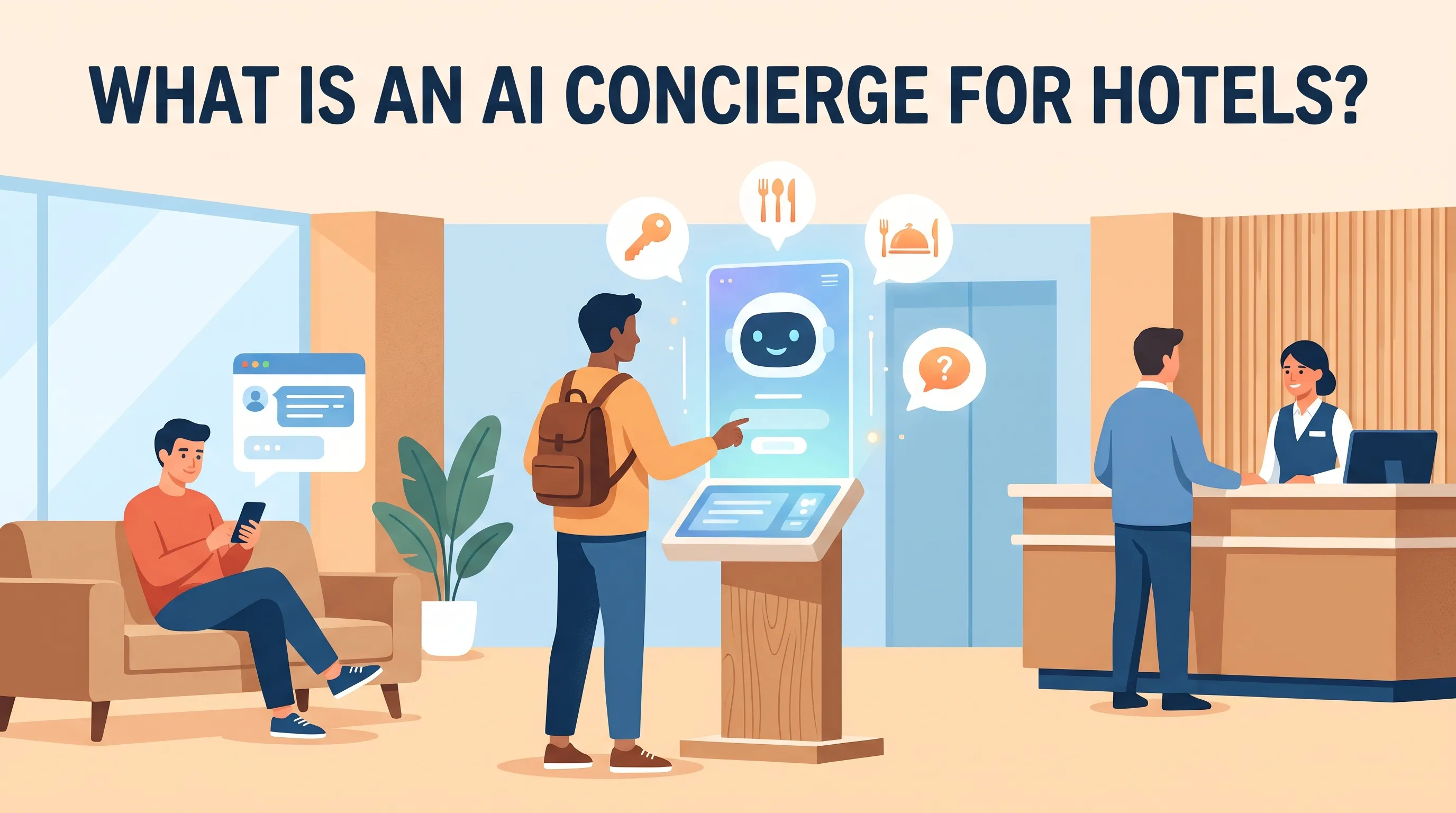
Which channels can it use?
The website, the booking path, messaging apps and screens in the hotel. On WhatsApp, Meta's rules in force since 15 January 2026 ban general-purpose AI assistants from the WhatsApp Business Solution, but businesses can still use AI to serve their own customers, as a hotel concierge does.
What are the limits and rules?
- Transparency: under Article 50 of the EU AI Act, applicable since 2 August 2026, guests must know they are talking to an AI, unless it is obvious. A simple sentence such as "I am the hotel's AI assistant" is enough.
- Accuracy: an AI can invent an answer. It must rely on up-to-date hotel information and hand over to a person when it is unsure.
- Human contact: always offer an easy way to reach the team.
- Data: process guest data in line with GDPR.
Our insight explains what changes: The EU AI Act Is Changing How Hotels Present Themselves.
How does Influence Society approach AI concierges?
At Influence Society, we help hotels define what their assistant should answer, structure the information it relies on, set its tone in line with the brand and check that it clearly presents itself as an AI.
Sources: European Commission, questions and answers on Article 50 of the AI Act; TechCrunch, "WhatsApp changes its terms to bar general purpose chatbots from its platform", updated January 2026 (accessed November 2026).
FAQ
Is an AI concierge the same as a hotel chatbot?
Not exactly. A classic chatbot follows scripted answers, while an AI concierge understands free questions and, when connected to the hotel's systems, can handle requests and bookings.
Can a hotel use an AI concierge on WhatsApp?
Yes. Since 15 January 2026, WhatsApp bans general-purpose AI assistants on its business solution, but businesses can still use AI to serve their own customers.
Does a hotel have to say its assistant is an AI?
In the EU, yes. Since 2 August 2026, Article 50 of the AI Act requires informing users that they are interacting with an AI, unless it is obvious.