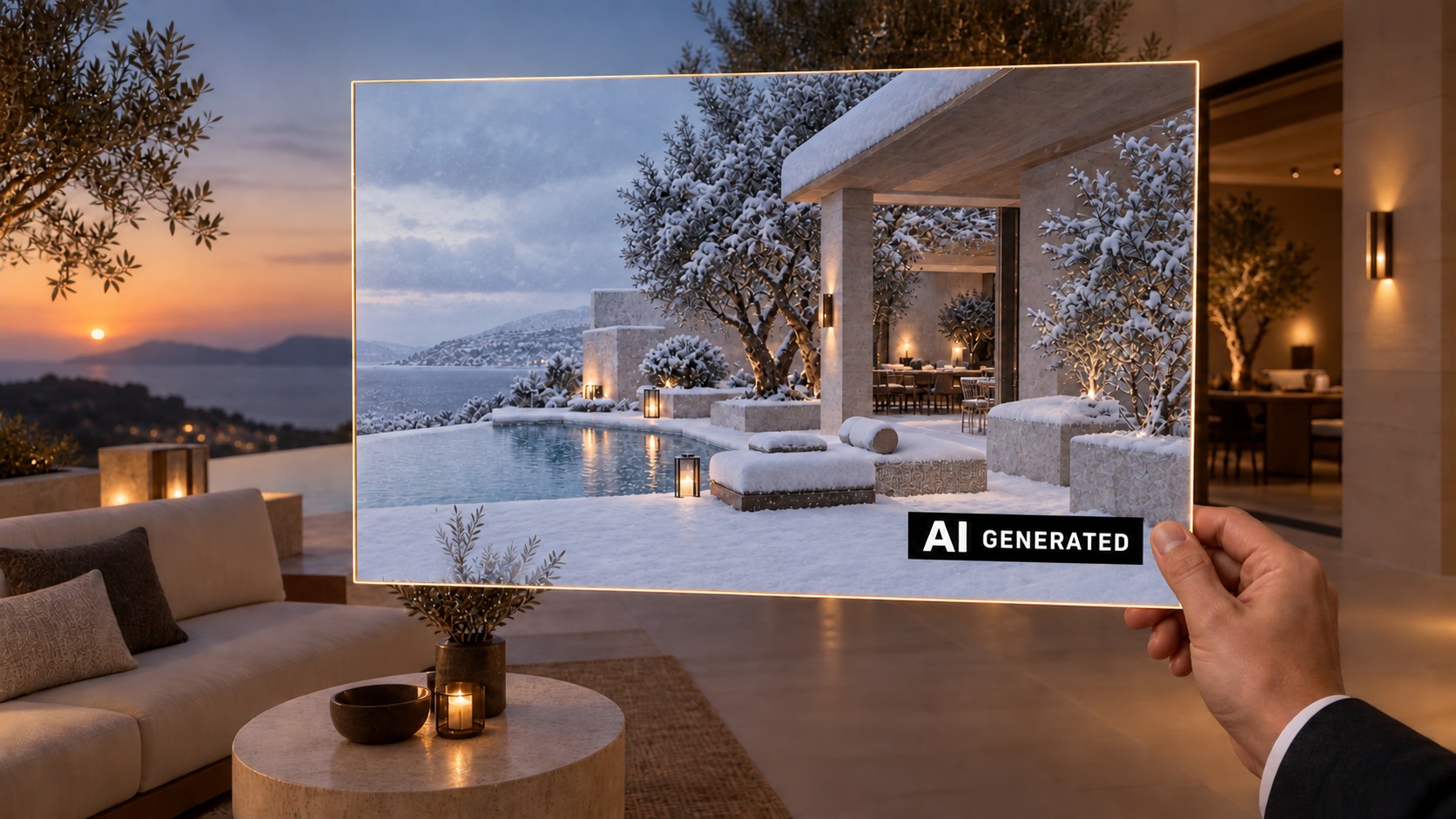
A photograph of a terrace becomes a winter scene. A still image of a suite becomes a film, complete with a guest opening the curtains. A digital concierge answers a question about the spa before anyone at reception sees it.
For hotel marketing teams, these are practical uses of AI: more creative possibilities, faster production and greater availability. They also introduce a question that matters particularly in luxury hospitality: what does the guest believe they are seeing or speaking to?
The EU AI Act brings legal requirements to that question. For hotels and their marketing partners, understanding them starts with the content and conversations already reaching guests.
Start with the rules that affect your marketing
The AI Act’s transparency requirements under Article 50 have applied since 2 August 2026. They cover interactions with certain AI systems, technical marking of generated content and disclosure requirements for certain AI-generated or manipulated content. They do not impose a visible label on everything produced with AI.
The distinction between a technology provider and a business using its tools matters. Providers have obligations concerning how systems are designed and must ensure that generated content carries a machine-readable technical marking, which may be invisible to the viewer. Businesses using AI professionally, described as “deployers,” must clearly disclose certain content, including deepfakes, to the people who encounter it. A hotel or its agency may qualify as a deployer, depending on how each uses the system. Their respective responsibilities therefore need to be established before publication.
A convincing image needs a clear purpose
“Deepfake” may suggest an impersonated politician. The definition also covers AI-generated or manipulated images, audio and video resembling existing places or objects and falsely appearing authentic. A realistic hotel visual can therefore fall within its scope.
The European Commission explicitly states that not all AI-generated content requires labelling. It has made a set of disclosure icons freely available, but businesses are not required to use those specific designs. They can use alternative labels or disclosure methods, provided these meet the Act’s transparency requirements. Choosing a different design does not remove the obligation to make the disclosure clear and accessible.
Consider the difference between preparing a campaign concept and publishing an image beside a booking button. A generated winter landscape might illustrate a seasonal idea. Presented as a photograph of the property, it could lead someone to expect snow conditions that the hotel cannot promise. The image’s placement and message deserve as much attention as its visual quality.
Before publishing an AI-generated or edited image, check what has been added, removed or altered, and whether the result could give guests a misleading impression of the room, view, facilities or experience.
Where disclosure is required, viewers must be able to see or hear it when they first encounter the content. An invisible technical marking is not enough on its own.
There is one further distinction to keep in mind. An “AI-generated” label tells guests how an image was made, but does not explain which features are real. If an image shows a swimming pool, a guest may reasonably assume the hotel has one and simply used AI to illustrate it. If no pool exists, the label alone may leave that misleading impression intact. Hotels must therefore meet both the AI disclosure requirements and existing consumer protection rules: identifying an image as AI-generated does not remove the need to represent the property’s actual facilities accurately.
Let guests know who is answering
An AI assistant can provide a useful first response while the team handles more personal requests. The interaction should begin with a clear understanding of what the assistant is.
Providers must design directly interactive systems so people know they are dealing with AI, unless that is obvious. The Commission says this exception should be interpreted narrowly.
For the hotel, a sensible implementation is a plain introduction: “I’m the hotel’s AI assistant.” It can carry the property’s tone without adopting a fictional employee identity.
A good practice is to pair that introduction with a straightforward route to the team. Test questions about accessibility, transfers, spa availability and special requests. A polished answer that promises something unavailable creates work for reception and disappointment for the guest.
Keep editorial judgement in the process
For written content, the disclosure requirement depends on what the text is intended to communicate. Ordinary marketing copy presenting a hotel’s rooms, facilities or special offers generally falls outside its scope. The rule concerns AI-generated or manipulated texts published to inform the public on matters of public interest, such as public health, environmental protection or economic developments relevant to public debate. A hotel blog article explaining how drought affects tourism in its region could therefore fall within its scope. A practical blog post suggesting local walks, places to visit or restaurants personally tried by the hotel team would generally fall outside this specific obligation, provided it stays focused on leisure recommendations rather than informing readers about a wider public-interest issue.
Even when a text covers a matter of public interest, an exemption can apply. The Commission distinguishes between “human review,” where someone with relevant knowledge checks the substance of the text, and “editorial control,” where an editor or editorial team assesses the content and exercises authority to approve it, require changes or reject it. Either process must go beyond spelling and grammar checks. In both cases, a person or organisation must also take editorial responsibility for the publication. When these conditions are met, the text does not require an AI label.
Beyond reviewing individual pieces of content, teams also need to understand the AI tools they use. The amended AI Act requires businesses to support the development of staff AI literacy, taking account of their knowledge and the context of use. It does not require guaranteeing a particular individual proficiency level.
For a hotel, this can mean practical guidance on recognising invented details, reviewing visuals and knowing when a question needs specialist advice.
Put responsibility into the production workflow
I would recommend four practical steps to bring these requirements into everyday production (this is a suggested workflow, not a checklist prescribed by the AI Act):
- Map the uses. Identify where AI creates content or communicates directly with guests, including work commissioned from agencies.
- Record material changes. Keep the original asset, the approved version and a brief explanation of significant alterations.
- Assign approval. Name who checks factual accuracy, brand consistency and any disclosure requirement before publication.
- Test the final placement. Review the website, advertisement or video as the guest encounters it. Check that required information remains readable across formats.
Helping hospitality brands explore AI with confidence is part of why we created Influence Society’s AI Studio. We combine art direction with the flexibility of generative AI, helping your team create distinctive photography and video that stay true to your property and your brand.
Explore Influence Society’s AI Studio.
Sources
- EU Artificial Intelligence Act — Regulation (EU) 2024/1689.
- Digital Omnibus on AI — Regulation (EU) 2026/1744.
- European Commission — Guidelines on transparency obligations.
- European Commission — Article 50 questions and answers.
- European Commission — Icons and content labelling.
- EU Unfair Commercial Practices Directive — Directive 2005/29/EC.