
In November 2025, a hotel marketing team shared a data set with me that crystallized a problem I have been watching build for two years. Their Google Analytics 4 dashboard reported $230,924 in direct revenue for the month. Their Property Management System told a different story: $317,457. The gap, $86,533, representing 27% of actual revenue, had simply disappeared from their reporting.
This was not a tracking error in the conventional sense. It was the signature of a broken consent infrastructure, and it was quietly distorting their campaign data, teaching their AI bidding algorithms to under-invest in their most valuable guests, and making a performing marketing strategy look like a failing one.
I am seeing this pattern across properties of all sizes in the United States. The assumption that data privacy is a European problem has become one of the most expensive misconceptions in hotel marketing.
America’s Privacy Shift
For the last decade, the US operated under a permissive digital framework. Third-party cookies tracked users freely, and compliance meant a privacy policy buried in the footer. That framework has unraveled.
The United States has not adopted a single federal privacy law. Instead, it has built what regulators are calling a “Splinternet”: a patchwork where a visitor’s digital rights change depending on which state they browse from. The foundation is California’s Consumer Privacy Act, amended into the CPRA. Unlike Europe’s opt-in model, California introduced an opt-out standard: businesses may collect data by default, but must provide a clear mechanism for users to withdraw, typically labeled "Do Not Sell or Share My Personal Information."
The definition of “share” under CPRA is the critical detail most hoteliers miss. It includes using a Meta Pixel or Google Ads tag for cross-context behavioral advertising. Running retargeting campaigns without a compliant opt-out mechanism constitutes a violation, regardless of whether a formal complaint has been filed. California also mandates recognition of Global Privacy Control (GPC) signals, browser-level settings that automatically signal a user’s desire to opt out. Most hotel websites cannot detect these signals at all.
The 2025 Compliance Wave
What changed in 2025 is the scale. Eight additional states activated privacy legislation, each with its own requirements, cure periods, and definitions of sensitive data.
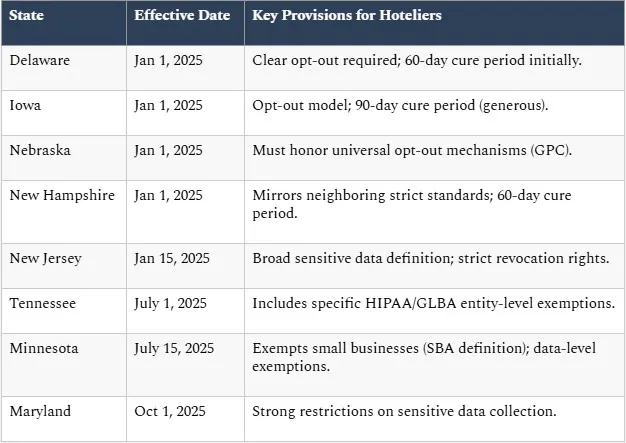
The operational implication is concrete. A single hotel website must now behave differently depending on whether the visitor connects from Trenton, Sacramento, or Paris. A visitor from Maryland may require specific disclosures around geolocation data. A visitor from Iowa requires a different opt-out mechanism. A visitor from the EU requires a strict opt-in banner before any tag fires.
Manually coding these variances is not feasible. This is where geolocation-based consent management moves from a nice-to-have to an operational requirement.
Enforcement Has Changed
The era of “nobody is really checking” is behind us. A consortium of privacy regulators from California, Colorado, Connecticut, Delaware, Indiana, New Jersey, and Oregon now coordinates investigations across state lines. A violation surfaced in one state can trigger a multi-state enforcement action.
The Federal Trade Commission is separately active, using Section 5 of the FTC Act to penalize dark-pattern interfaces: consent designs that make opting out deliberately difficult, pre-checked consent boxes, or rejection flows buried behind multiple screens. The risk for independent hotels is not only the fine. It is the operational cost of a forced audit, and the more immediate damage of a marketing team that cannot prove its performance to ownership when reported revenue appears 27% below what the PMS records.
What Is Actually Breaking on Your Website
The regulatory shift is one dimension of the problem. The technical infrastructure beneath most hotel websites is already failing through three distinct fractures, independent of any compliance question.
Browser hostility. Safari and Firefox block third-party cookies by default. Chrome is transitioning to a privacy-first architecture. This dismantles view-through attribution: a guest who sees your resort ad on Instagram while commuting, ignores it, then searches and books from their laptop two days later now appears as two unrelated events. The Instagram ad registers as a failure. Over time, budgets migrate toward branded search, the channel that captures demand already created, while social and display, the channels that generate it, are quietly defunded.
The booking engine disconnect. This fracture is unique to hospitality and largely invisible to hoteliers. A hotel’s marketing site and its booking engine almost always live on separate domains. Tracking a user across these domains requires passing identifiers via the URL, a method that modern privacy protocols increasingly strip. If the user consents on the marketing site but that consent signal is not transmitted to the booking engine, the engine treats them as a new, unconsented visitor. A second banner appears. The user, fatigued, rejects it. The conversion data never returns to the advertising platform.
One of our clients experienced this as a $0 ROI report on a Facebook campaign that had generated 140 clicks at a 4.28% click-through rate. The conversions were happening. The tracking had broken between the ad click and the booking confirmation page.
Meta’s specific blindness. Since Apple’s App Tracking Transparency framework, over 90% of iOS users opt out of cross-app tracking. The Meta Pixel, a browser-side tool, cannot see these users. For properties where a significant share of social traffic arrives from iPhone users, campaign cost-per-acquisition inflates because Meta has no visibility into who is actually converting. The solution, Meta’s Conversions API, requires sending booking confirmation data directly from the hotel’s server to Meta, bypassing the browser entirely. Implemented correctly, it closes the gap. Implemented without proper consent management, it creates a compliance violation.
The Recovery Mechanism
Google’s response to the signal loss is Consent Mode v2. The distinction between what it does and what it does not do matters for setting honest expectations.
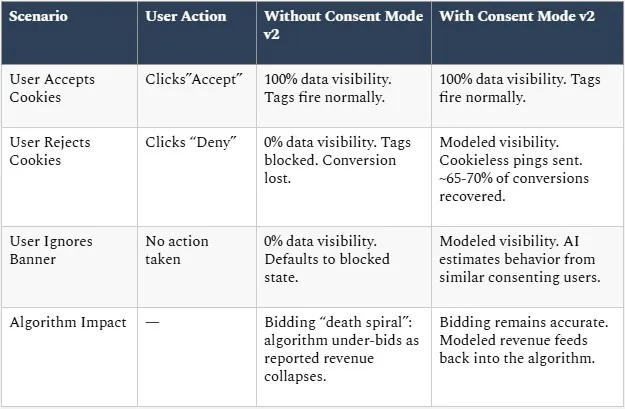
Consent Mode does not prevent data loss for users who decline consent. What it does is enable AI-powered behavioral modeling to estimate the behavior of those users based on the patterns of consenting users. Tags load in the background, without reading or writing cookies for users who decline, sending only anonymous signals confirming that a conversion occurred, without identifying who converted. Google’s AI uses these signals to model the missing conversions.
Studies show that Advanced Consent Mode recovers approximately 65 to 70% of ad-click-to-conversion journeys that would otherwise be invisible. Google’s internal data indicates an average 18% conversion rate uplift for advertisers using consent modeling compared to those relying on observed data alone. For Air France, implementation produced a 9% conversion uplift across European markets.
The strategic implication for bidding algorithms is direct. Automated strategies like Target ROAS require a continuous stream of conversion signals to function correctly. Without Consent Mode, a campaign generating a genuine 10x return may show a 4x return in the dashboard, because a significant share of conversions are invisible. The algorithm responds by suppressing spend, cutting visibility during critical booking windows. With modeled conversions fed back into the bidding engine, the system bids on accurate signals.
Consent as a Design Choice, Not a Legal Box
There is a dimension of this problem that is specific to the luxury hospitality sector, and it is the one I find most consequential from a brand perspective.
Standard cookie banners are designed by compliance teams, not marketers. They are intrusive overlays built to minimize legal liability by making rejection the path of least resistance. On a luxury hotel website, where the digital experience is meant to be the first expression of the property’s character, hitting a guest with a legalistic wall at the moment of arrival is a form of poor service.
The consent interface is, in practice, part of the digital lobby. A well-designed consent experience, one that uses the hotel’s typography, color palette, and tone of voice, one that asks “May we personalize your stay?” rather than displaying a wall of checkboxes, produces measurably different outcomes. A customized consent approach at the Paris Opera produced an 84% consent rate. A higher consent rate means more observed data, which reduces reliance on modeling and increases accuracy across the entire data pipeline.
Geolocation-based consent management resolves the operational complexity: a strict opt-in banner for European visitors, a CCPA-compliant opt-out notice for Californians, and a simplified configuration for visitors from states with no active legislation. This prevents over-compliance, the trap of applying European opt-in rules globally and unnecessarily restricting data collection from domestic US travelers where it is not legally required.
The OTA Argument
There is one additional consequence of a broken consent infrastructure that deserves direct attention from hotel owners: its effect on the competitive position against OTAs.
Booking.com and Expedia bid aggressively on branded hotel keywords. They operate with robust first-party data infrastructures and are structurally less reliant on third-party cookies than independent hotels. When a hotel’s tracking is degraded, its conversion data in Google Ads deteriorates. Google’s system perceives a lower conversion rate, which reduces the ad’s Quality Score. A lower Quality Score means a higher cost-per-click to maintain the top position on a branded search.
The hotel pays more to defend its own name, while the OTA, operating with a cleaner data pipeline, maintains a structural cost advantage. Restoring data visibility through consent infrastructure is, among other things, a brand protection strategy.
Where to Start
The implementation follows a logical sequence.
- Audit the current state of consent on both the marketing site and booking engine simultaneously. The booking engine is as important as the main site. A consent signal that does not cross the domain boundary is a broken pipeline.
- Implement Google Consent Mode v2 in Advanced Mode via Google Tag Manager. This requires removing legacy blocking triggers and replacing them with Consent Mode’s native consent checks, allowing tags to operate in the cookieless signal state when users decline.
- Configure geolocation rules to serve the appropriate consent experience by jurisdiction. This single step addresses both legal compliance and the over-compliance trap.
- Activate Enhanced Conversions in Google Ads. This feature hashes first-party data captured during booking (email, phone number) and transmits it to Google, enabling cross-device conversion matching even in the absence of cookies.
- Implement Meta’s Conversions API for server-side tracking. This bypasses browser restrictions and iOS opt-outs by sending booking confirmation data directly from the hotel’s server.
The clearest measure of progress is a monthly reconciliation between PMS revenue and GA4 revenue. As modeled conversions populate, the gap narrows.
The Cost of Invisibility
The cost of a consent management platform is, in most cases, less than the value of a single room night per month. The cost of the data gap it addresses can be measured in hundreds of thousands of dollars of misattributed revenue and algorithmic spend suppressed on the basis of false signals.
The conversation about consent has moved from the legal department to the revenue table. For independent hotels competing against OTAs with sophisticated data infrastructure, the quality of consent architecture is now part of the competitive landscape.
The US privacy environment will continue to fragment. More states are legislating. Federal coordination is advancing. Hotels that build compliant consent infrastructure now will be measuring revenue their competitors cannot see.
A question worth sitting with: does your marketing team currently know the true gap between what your dashboard reports and what your PMS records? If not, you have already begun to answer it.
Sources
US Privacy Legislation
White& Case — “2025 State Privacy Laws: What Businesses Need to Know forCompliance”
https://www.whitecase.com/insight-alert/2025-state-privacy-laws-what-businesses-need-know-compliance
IAPP— “US State Privacy Legislation Tracker”
https://iapp.org/resources/article/us-state-privacy-legislation-tracker/
BloombergLaw — “Which States Have Consumer Data Privacy Laws?”
https://pro.bloomberglaw.com/insights/privacy/state-privacy-legislation-tracker/
TechPolicy.Press— “The Year US Regulators Got Serious About Cookie Consent”
https://www.techpolicy.press/the-year-us-regulators-got-serious-about-cookie-consent/
Google Consent Mode v2
GoogleAds Help — “About consent mode modeling”
https://support.google.com/google-ads/answer/10548233
GoogleBlog — “Unlocking the full value of Consent Mode”
https://blog.google/products/marketingplatform/360/unlocking-consent-mode-value/
Googlefor Developers — “Consent mode overview”
https://developers.google.com/tag-platform/security/concepts/consent-mode
Hospitality Industry
Axeptio— “Consent Rate Optimization: the Paris Opera case study”
https://www.axept.io/blog/opera-de-paris
Note: Axeptio is the vendorbehind the Paris Opera case study. The 84% consent rate figure originates fromtheir own published data.
Cendyn— “Hotel digital marketing faces rising performance challenges”
https://www.cendyn.com/news/as-clicks-fade-hotel-digital-marketing-confronts-a-new-era-of-increasing-compliance/