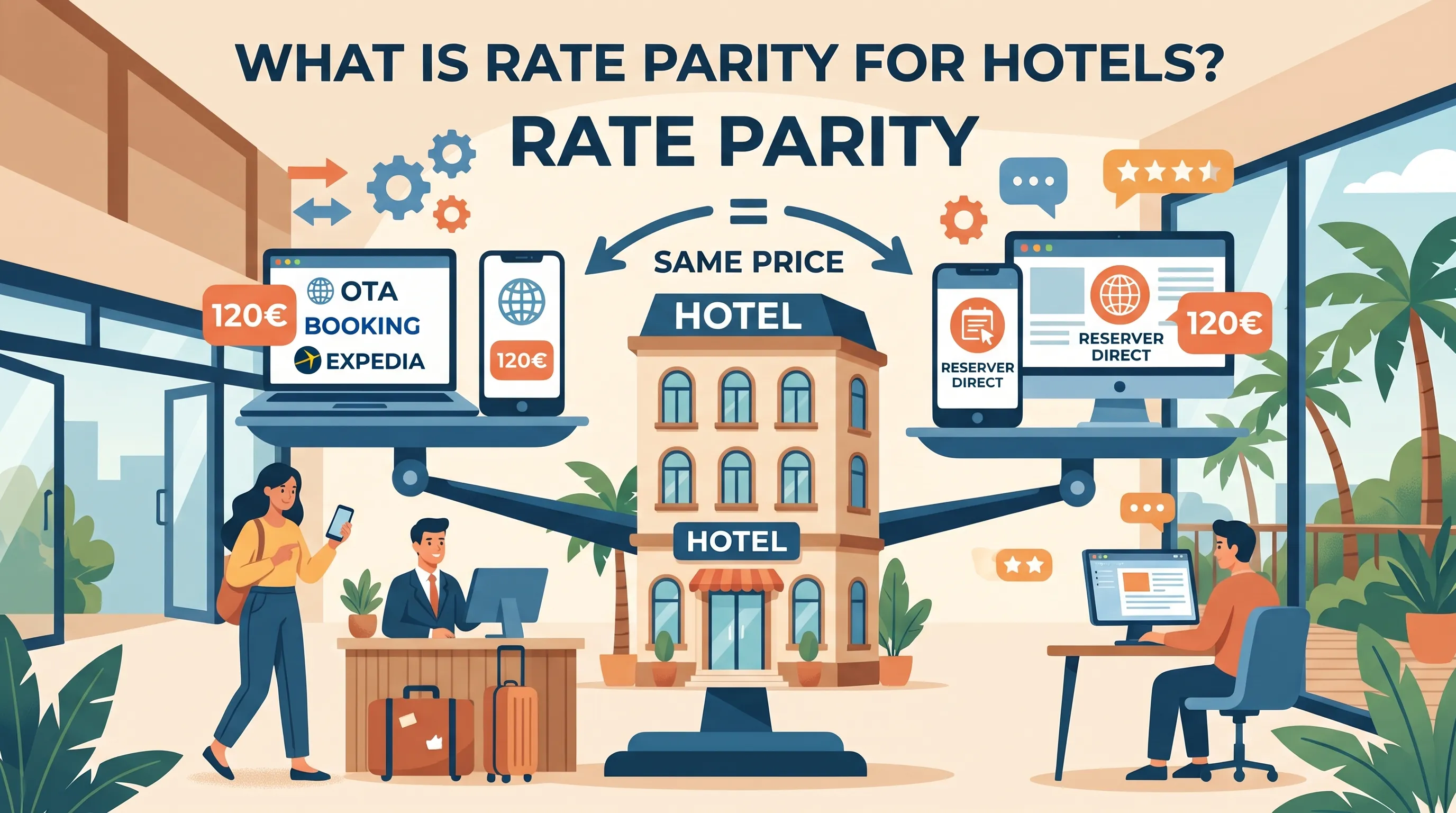
Rate parity means that a hotel shows the same price for the same room and conditions on every distribution channel: its own website, OTAs such as Booking.com or Expedia, and metasearch sites. For years, OTAs imposed it through parity clauses. In France, the 2015 Macron law gave hotels back their freedom to set prices, and in the European Union the Digital Markets Act now bans Booking.com from imposing parity. Parity is therefore a strategic choice for the hotel, not an obligation, but it still shapes how the hotel looks on metasearch.
Key takeaways
- Rate parity is the same price, for the same room and conditions, across all channels.
- French law and the EU Digital Markets Act let hotels offer lower prices on their own website.
- On metasearch, any gap with OTAs is visible instantly and influences where the guest books.
What are parity clauses?
A parity clause is a contract term in which an OTA requires the hotel not to offer better prices or conditions elsewhere.
- Wide parity: the hotel cannot be cheaper on any other channel, including other OTAs.
- Narrow parity: the hotel cannot be cheaper on its own website, but can be on other OTAs.
Both limit the hotel's ability to reward direct bookings, which carry no commission. See our article on OTA commissions.
What does the law say in France and in the EU?
- France: the Macron law of 6 August 2015 defines the contract between a hotel and a booking platform as a mandate. The hotel remains free to set its prices and to grant any discount, and parity clauses are void.
- European Union: Booking.com was designated a gatekeeper under the Digital Markets Act (DMA) and has had to comply since 14 November 2024. It cannot prevent accommodation providers from offering different prices or conditions on other channels, including their own website. Booking.com removed parity requirements from its EEA terms in July 2024, and in September 2026 stopped using external prices to decide eligibility for its Booking Sponsored Benefit programme.
Outside the EU, rules depend on the country and on each contract, so terms should be checked market by market.
Why does rate parity matter on metasearch?
Google Hotels, Tripadvisor and Trivago display the hotel's direct rate next to OTA rates. If an OTA is cheaper, often because of a member discount, a wholesaler reselling rates or a promotion, the guest clicks on the OTA and the hotel pays a commission. If the direct rate is equal or better, the hotel's own link becomes the obvious choice. Read our guides on hotel metasearch and on managing metasearch campaigns.
How can a hotel monitor and use rate parity?
- Track prices daily with a rate shopper or a parity tool; see tools to collect real-time hotel pricing data.
- Distribute rates and availability through a channel manager to avoid input errors.
- Investigate each disparity: wholesaler contracts, OTA promotions, currency or tax display.
- Decide a direct booking advantage: a slightly lower rate, breakfast, flexible cancellation or a member price, displayed clearly on the website and on metasearch.
How does Influence Society work with rate parity?
At Influence Society, we connect metasearch and Google Ads campaigns to the hotel's direct rate, flag disparities that cost bookings, and help the hotel present its direct booking benefits on its website, in line with the strategy set by its revenue team.
Sources: Légifrance, law no. 2015-990 of 6 August 2015 (Macron law); European Commission, Digital Markets Act factsheet on Booking.com, 28 September 2026 (accessed November 2026).
FAQ
Is rate parity mandatory for hotels?
No. In France, the Macron law voids parity clauses, and in the EU the Digital Markets Act bans Booking.com from imposing them. A hotel can choose to keep parity, or to offer a better rate or benefit on its own website.
Why is a hotel cheaper on an OTA than on its own website?
Usually because of an OTA member discount or promotion, a wholesaler reselling rates without permission, or a display difference in taxes or currency. Each gap should be traced back to its source.
How does rate parity affect metasearch results?
Metasearch sites show the direct rate next to OTA rates. When the direct rate is equal or lower, the hotel's own link attracts more clicks and bookings without commission.