An OTA, or online travel agency, is a website that sells hotel rooms on behalf of hotels and takes a commission on each booking, such as Booking.com or Expedia. A hotel metasearch, such as Google Hotels or Trivago, only compares prices from several sellers and sends the traveler to the site of their choice to book.
Key takeaways
- An OTA sells and collects the booking; a metasearch compares and redirects.
- In Europe, 51.3% of hotel bookings are direct and 29.9% go through OTAs (HOTREC, 2025 data).
- Booking Holdings and Expedia Group account for 85.4% of the European OTA market.
What is an OTA?
An online travel agency lists thousands of hotels, takes the booking and payment, and sends the reservation to the hotel. In exchange, the hotel pays a commission set in its contract, generally a double-digit percentage of the room revenue.
OTAs bring visibility, especially with international guests who do not know the hotel yet. But the guest's contact details and the relationship belong largely to the platform, which makes loyalty and upselling harder.
What is a hotel metasearch?
A metasearch engine displays, for the same hotel and dates, the prices offered by several sellers: OTAs and the hotel's own website. The traveler clicks the offer of their choice and is redirected to book.
The main players are Google Hotels, Trivago, Kayak and Tripadvisor. The hotel can appear there for free, for example through Google's free booking links, or pay for more visibility with formats such as Google Hotel Ads, usually billed per click or as a commission.
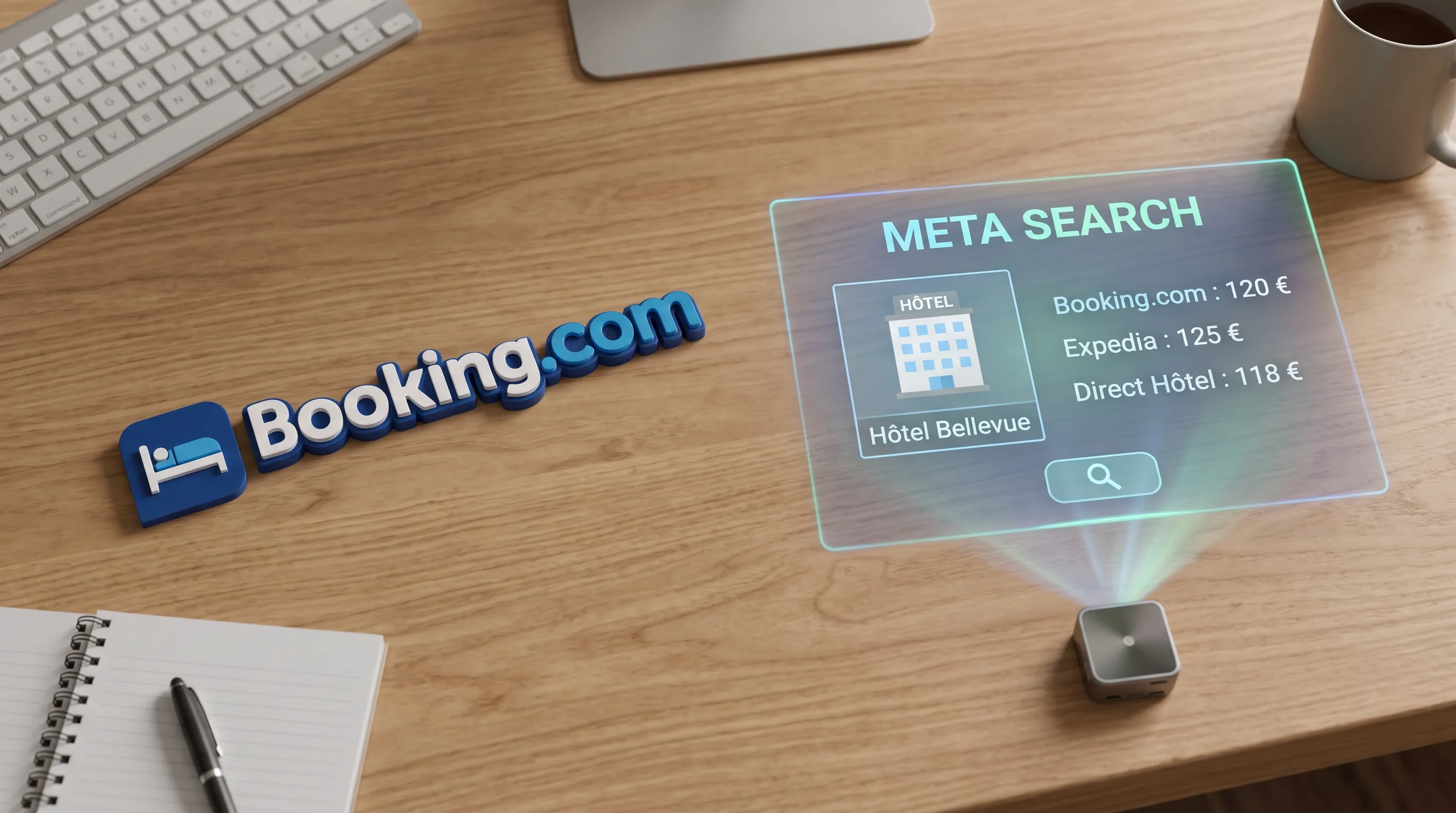
OTA, metasearch or direct website: what are the differences?
The three channels play different roles:
- OTA: sells the room and collects the booking. Paid by commission. The guest relationship mostly stays with the platform.
- Metasearch: compares prices and redirects. Paid per click or per booking, or free for some listings. The booking is made on the site chosen by the guest.
- Direct website: the hotel sells through its own booking engine. No commission, apart from the booking engine subscription and acquisition costs. The hotel keeps the guest data and the relationship.
How much weight do OTAs carry today?
According to HOTREC's European Hotel Distribution Study (2026 edition, 2025 data), direct bookings still account for 51.3% of hotel bookings in Europe, while OTAs have risen to 29.9%, compared with 19.7% in 2013. The market is highly concentrated: Booking Holdings holds 68.8% of OTA bookings and Expedia Group 16.6%. The same study measures higher cancellation rates on OTA bookings than on direct ones: 19.0% for Booking.com and 11.7% for Expedia, against 9.1% for direct bookings.
Since Booking.com was designated a "gatekeeper" under the EU Digital Markets Act in May 2024, it can no longer impose parity clauses: hotels are free to offer lower prices on their own website.
How do you balance OTAs and direct bookings?
The goal is not to leave OTAs but to use them as a showcase while bringing loyal and returning guests to the direct channel:
- Be visible on metasearch: connect your booking engine to Google's free booking links via your Google Business Profile so your direct rate appears next to the OTAs.
- Give a reason to book direct: best price, flexible conditions, breakfast or a late check-out reserved for the website.
- Manage distribution centrally: a channel manager keeps rates and availability consistent across every channel.
How does Influence Society approach distribution?
At Influence Society, we start from each hotel's channel mix to set a direct booking target, then combine SEO, metasearch and paid campaigns to reach it. OTAs remain useful partners; the aim is to reduce dependence on them, not to remove them.
Sources: HOTREC, European Hotel Distribution Study 2026 (2025 data), reported by UMIH and Hospitality ON; European Commission, Digital Markets Act, Booking designated as gatekeeper on May 13, 2024 (consulted October 2026).
FAQ
Is an OTA essential for a hotel?
Rarely essential, but often useful: OTAs give visibility abroad and fill low periods. Most hotels combine OTAs with a strong direct channel.
How much commission does an OTA take?
The rate is set in each hotel's contract and varies by platform, destination and visibility program. It generally represents a double-digit percentage of the booking.
Can you book directly on a metasearch?
In most cases, the metasearch redirects the guest to the OTA or hotel website to finalize the booking. Some formats allow booking without leaving the comparison page.