Hotel digital marketing is the set of online actions a hotel uses to be found, chosen and booked directly: its website, SEO and GEO, paid search, metasearch, social media, email and CRM, and online reputation. Its goal is not traffic alone but direct revenue, at a lower cost than OTA commissions.
Key takeaways
- In Europe, direct bookings represented 51.3% of hotel bookings in 2025 and OTAs 29.9%, according to HOTREC.
- No single lever is enough: visibility on Google and in AI answers, paid campaigns and guest loyalty work together.
- The hotel's own website and booking engine are where every lever should convert.
What does hotel digital marketing cover?
It covers the whole online journey of a guest, from inspiration to the return visit. A traveler may discover a hotel on Instagram, compare it on Google or ChatGPT, check its rate on a metasearch engine, read its reviews, then book on the hotel's website and receive a pre-stay email. Each of these steps is a marketing lever the hotel can work on.
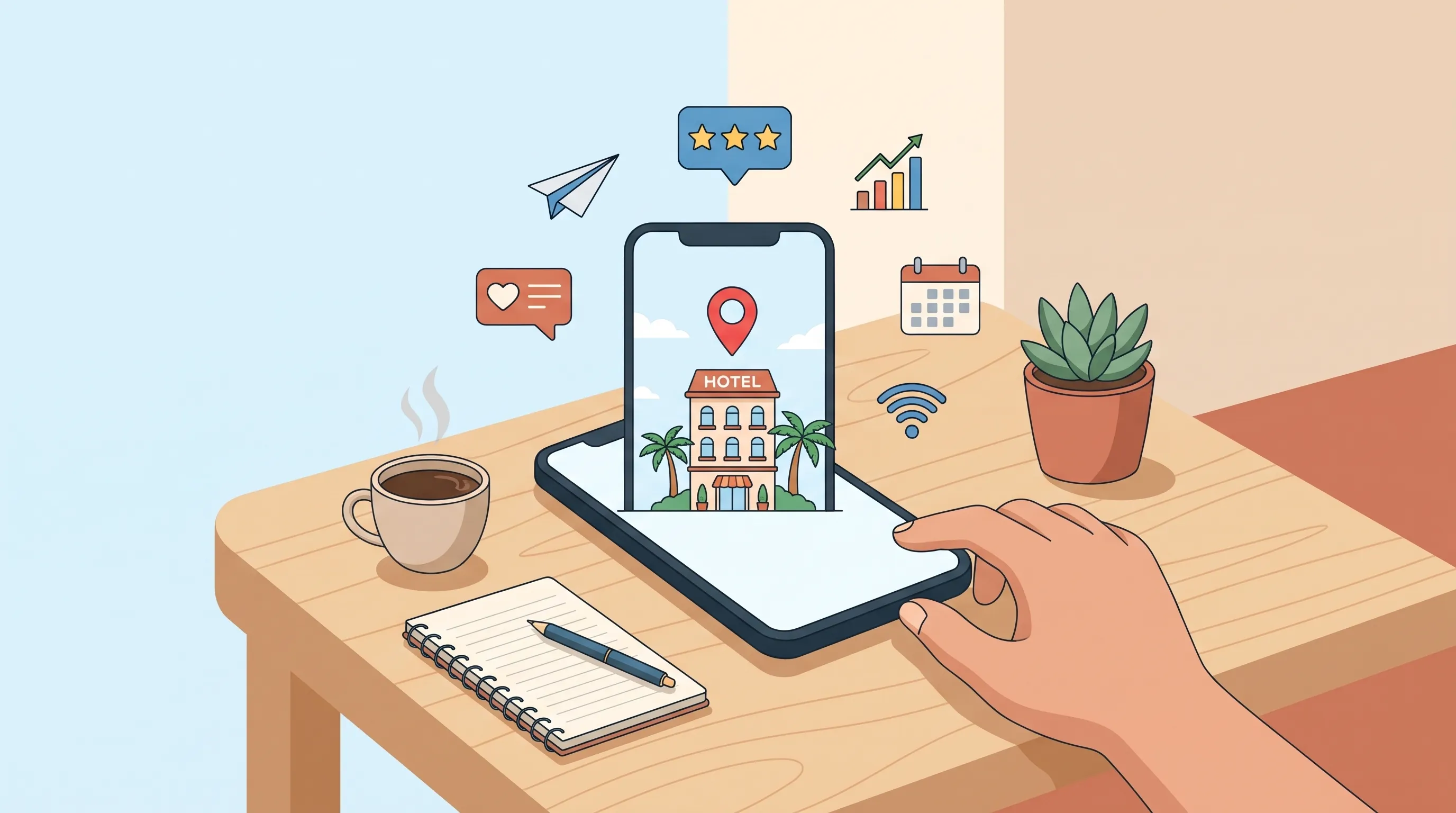
What are the main levers of hotel digital marketing?
- SEO and GEO: being visible on Google and cited in AI answers. See our guides to SEO for hotels, GEO and the SEO and GEO & AI Search categories.
- Paid search: Google Ads campaigns, including brand protection, and now ChatGPT Ads. Browse the Google Ads category.
- Metasearch: your direct rate on Google Hotel Ads, trivago or Tripadvisor. Browse the Metasearch category.
- Social media: community management and social ads on Instagram, Facebook or TikTok.
- CRM and email: a hotel CRM and email campaigns to win repeat stays.
- E-reputation: reviews and replies on Google, Tripadvisor and the OTAs. Browse the E-reputation category.
- Website and booking engine: a fast site and a booking engine that turns visits into bookings.
How do you build a hotel digital marketing strategy?
- Set goals: direct revenue, share of direct bookings, occupancy on low seasons, sales for the restaurant or spa.
- Know your guests: markets, booking windows and the channels they use.
- Fix the foundations: website speed, booking engine, tracking and Google Business Profile.
- Choose and budget the levers: start with high-intent channels (brand search, metasearch), then build visibility and loyalty.
- Measure and adjust: follow results in a dashboard and reallocate budget every month.
Which KPIs should a hotel track?
- Direct revenue and the share of direct bookings versus OTAs;
- website conversion rate and booking engine abandonment;
- cost per booking for each paid channel, compared with OTA commission;
- visibility on Google, in AI answers and on metasearch;
- review score and repeat guest rate.
Our guide on how to increase direct bookings details the levers with the strongest impact on these figures.
How does Influence Society approach hotel digital marketing?
At Influence Society, we work on the full chain, from visibility to conversion, for luxury hotels and restaurants. We start with an audit of the website, tracking and channels, then build a plan with clear priorities and a dashboard that ties every lever to direct revenue. Browse all our guides on the Influence Society wiki.
Sources: HOTREC European Hotel Distribution Study, 2025 data, published September 2026, as reported by Hospitality Net, October 21, 2026 (accessed November 2026).
FAQ
What is the difference between hotel marketing and hotel digital marketing?
Hotel marketing covers all actions that promote a hotel, offline and online. Hotel digital marketing focuses on online channels: website, search, ads, social media, email and reviews.
Which digital channel brings the most bookings to a hotel?
It depends on the property, but in Europe direct channels represented 51.3% of hotel bookings in 2025, ahead of OTAs at 29.9%, according to HOTREC.
Where should a small hotel start with digital marketing?
With the foundations: a fast website, a reliable booking engine, conversion tracking and a complete Google Business Profile, then a brand search campaign and metasearch.